How does birth control actually work?
Treating and managing acne, PCOS, endo and more
Sexual Health
There are many birth control methods available. They’re typically divided into hormonal versus non-hormonal.
Hormonal methods use either synthetic estrogen and progesterone or a combination of the two to prevent pregnancy. Non-hormonal methods (IUDs, barrier methods) either use a barrier to prevent pregnancy or create hostile conditions for sperm.
It is important to note that most birth control does not protect you against STIs: condoms are the only method that helps stop conditions like chlamydia, gonorrhea, and herpes.
Let’s start with periods aka the menstrual cycle
The beginning of the menstruation period (when you start bleeding) is typically Day 0 of your cycle. At the most basic level, menstruation is the shedding of the lining of your uterus when there is no fertilized egg implanting as the start of a pregnancy.
Ovulation occurs about 14 days before your period begins and is when a follicle matures enough to create an egg in the ovarian tubes. Once it’s mature enough, it travels down into the uterus. It’s now ready to be fertilized by a sperm to begin the creation of a fetus. If there is no sperm in the uterus during ovulation, the unfertilized egg will be removed via the menstruation period.
The part of the cycle from the menstrual period to ovulation is called the follicular phase, basically when the egg is maturing.
The 14 day period after ovulation and before your period begins is called the luteal phase and is when you’re most fertile with the highest chance of getting pregnant. It can be difficult to determine when ovulation begins if you have an irregular cycle, however you can approximate when ovulation was for your previous cycle.
Many people who menstruate track it using an app in order to be prepared for their period and identify their most fertile phase (either to have a baby or prevent one!).
The typical menstrual cycle is between 21-36 days.
How do hormonal contraceptives work?
Birth control elevates hormone levels, making the body seem like it is pregnant. This will prevent ovulation as your body thinks there’s already a baby brewing.
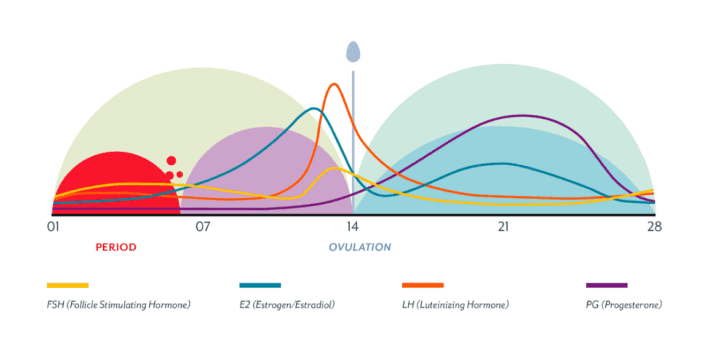
Synthetic hormones block ovulation in the brain. Normally your menstrual cycle is controlled by a complex pathway starting with the release of gonadotropin releasing hormone (GnRH) from the hypothalamus in the brain. This triggers a cascade of hormones during your menstrual cycle. As seen in the diagram above, a surge of LH (luteinizing hormone) mid-cycle causes ovulation, and you are most fertile around this time. LH also stimulates testosterone production to increase your libido (

). Estrogen tends to be higher at the beginning of your cycle and progesterone higher after ovulation.
The progesterone in birth control blocks the surge of LH, which stops ovulation from occuring. Estrogen blocks production of FSH (follicle stimulating hormone) which means the follicles where eggs are produced will not mature. The two drugs work together to prevent pregnancy.
The second way of preventing pregnancy is via the thickening of cervical mucus (prevents sperm movement into the uterus) and delayed endometrial thickening (which prevents implantation of an fertilized egg into the wall of the uterus), and can also help with dysmenorrhea (painful periods).
How do non-hormonal contraceptives work?
Non-hormonal contraceptives work in two main methods: by blocking sperm (lil swimmers) from entering the cervix or by creating a hostile environment where sperm and eggs cannot survive.
Blocking sperm | Hostile environment |
|---|---|
Condoms | Spermicide |
Diaphragms | Copper IUDs |
Sources:
Therapeutic Choices (2019) – Canadian Pharmacists Association
Micromedex
Image from clue.
https://flo.health/menstrual-cycle/sex/birth-control/copper-iuds
Questions? Contact us anytime on the site chat or at hello@jill.health
Questions? Contact us anytime on the site chat or at hello@jill.health
What We Treat
About Us
Medications
Questions? Contact us anytime on the site chat or at hello@jill.health
What We Treat
About Us
Medications