
Mastering Stress: Using the Circles of Control Framework To Manage Stress Reactions
Weight Loss
Certain levels of stress are a normal part of life. What often determines whether stress is healthy or not is our response to it. Stress can manifest in various forms, such as work-related pressures, personal worries, or global events. When stress persists over extended periods and leads to unhealthy coping strategies, it can significantly impact our mental and physical well-being. Fortunately, there exists a powerful framework that has the potential to transform our perception of and approach to stress – the Circles of Control. In this comprehensive guide, we will delve into the concept of Circles of Control, explore its implications, and learn how to harness it to effectively manage the stressors in our lives.
Understanding Circles of Control
The Circles of Control is a concept that helps us categorise the aspects of our lives based on the level of control we have over them. It’s a visual representation that divides our concerns into three main categories: the Circle of Control, the Circle of Influence, and the Circle of Concern [1].
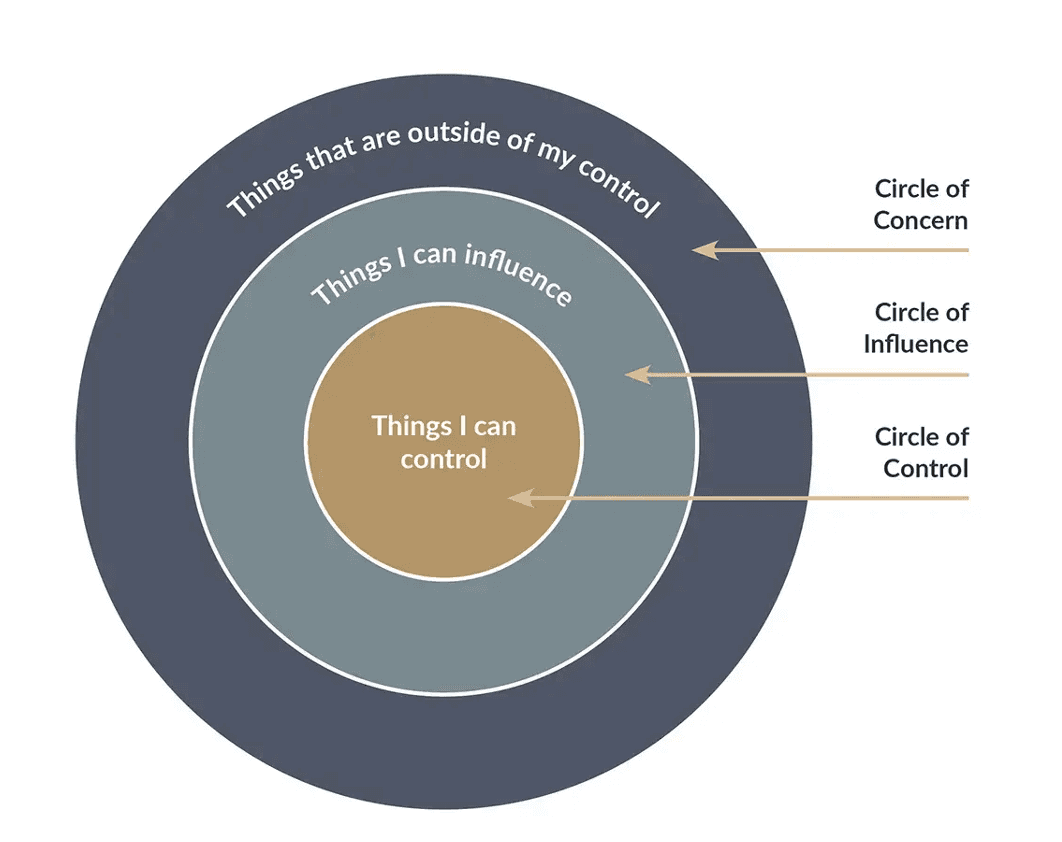
Circle of Control: This innermost circle represents elements that are entirely within our control. This includes our thoughts, attitudes, behaviours, and actions. We have the power to change and manage these aspects effectively.
Circle of Influence: The second circle includes elements that we may not have direct control over, but we can certainly influence them. This comprises our relationships, our environment at work or home, and our health to some extent. While we might not have full control, we can exert influence through our actions and decisions.
Circle of Concern: The outermost circle encompasses elements that we cannot control or directly influence. This involves global issues, other people’s behaviours, or circumstances beyond our sphere of influence. Focusing too much on this circle can lead to stress and anxiety, as we cannot change these aspects single-handedly.
Harnessing the Power of Circles of Control
Now that we understand the three circles, let’s explore how we can leverage this framework to manage stress effectively and lead a more balanced life.
Identify and Acknowledge Your Circles
The first step is to recognize the elements within each circle. Take a moment to list out what falls into your Circle of Control, Circle of Influence, and Circle of Concern. This exercise creates a visual representation of your spheres of influence and helps you gain clarity on what you can and cannot control [2].
Focus on Your Circle of Control
Place your primary focus and energy on the Circle of Control. By doing so, you empower yourself to manage stress more effectively. Concentrate on your thoughts, actions, and reactions to different situations. This proactive approach enhances your well-being and reduces stress levels [3].
Exercise Positive Thinking
Within your Circle of Control, strive for positive thinking. Shift your mindset from a negative outlook to a more optimistic and constructive perspective. Your thoughts shape your reality, and fostering positivity can significantly impact how you respond to stressors in your life [4].
Develop Healthy Coping Mechanisms
Recognize stressors within your Circle of Control and establish healthy coping mechanisms to deal with them. Whether it’s regular exercise, mindfulness practices (we like Progressive Muscle Relaxation), or seeking professional help, adopting strategies to manage stress positively is vital [5]
Influence Your Circle of Influence Wisely
Within your Circle of Influence, make conscious efforts to exert a positive impact. Strengthen your relationships, communicate effectively, and actively engage with your environment. By doing so, you expand your influence and indirectly reduce stress in your life [6].
Practice Letting Go
For concerns in the Circle of Concern, practise the art of letting go. Understand that you cannot control everything. Instead of allowing these concerns to consume your thoughts and energy, focus on what you can control and let the rest go [7].
Conclusion
The Circles of Control framework is a game-changer when it comes to managing stress and enhancing overall well-being. By recognizing and categorising our concerns, we can channel our efforts and energy where it matters the most. Embrace this powerful tool, regain control over your life, and experience a newfound sense of calm amidst life’s challenges.
Ready to start your weight loss journey?
References:
Covey, S. R. (1989). The 7 Habits of Highly Effective People: Powerful Lessons in Personal Change. Simon & Schuster.
MindTools. (n.d.). The Circle of Influence and Concern. [https://www.mindtools.com/pages/article/newLDR_90.htm]
Harvard Health Publishing. (2011). Understanding the stress response. [https://www.health.harvard.edu/staying-healthy/understanding-the-stress-response]
Mayo Clinic. (2021). Positive thinking: Stop negative self-talk to reduce stress. [https://www.mayoclinic.org/healthy-lifestyle/stress-management/in-depth/positive-thinking/art-20043950]
Canadian Mental Health Association. (n.d.). Stress. [https://cmha.ca/documents/stress]
MindTools. (n.d.). The Circle of Influence and Control. [https://www.mindtools.com/pages/article/newLDR_90.htm]
Forbes Coaches Council. (2019). Nine Effective Strategies To Stop Worrying. [https://www.forbes.com/sites/forbescoachescouncil/2019/08/13/nine-effective-strategies-to-stop-worrying]
Questions? Contact us anytime on the site chat or at hello@jill.health
Questions? Contact us anytime on the site chat or at hello@jill.health
What We Treat
About Us
Medications
Questions? Contact us anytime on the site chat or at hello@jill.health
What We Treat
About Us
Medications